

In - Equal Measure
May 30 - June 27, 2026 at Akar Prakar, Delhi
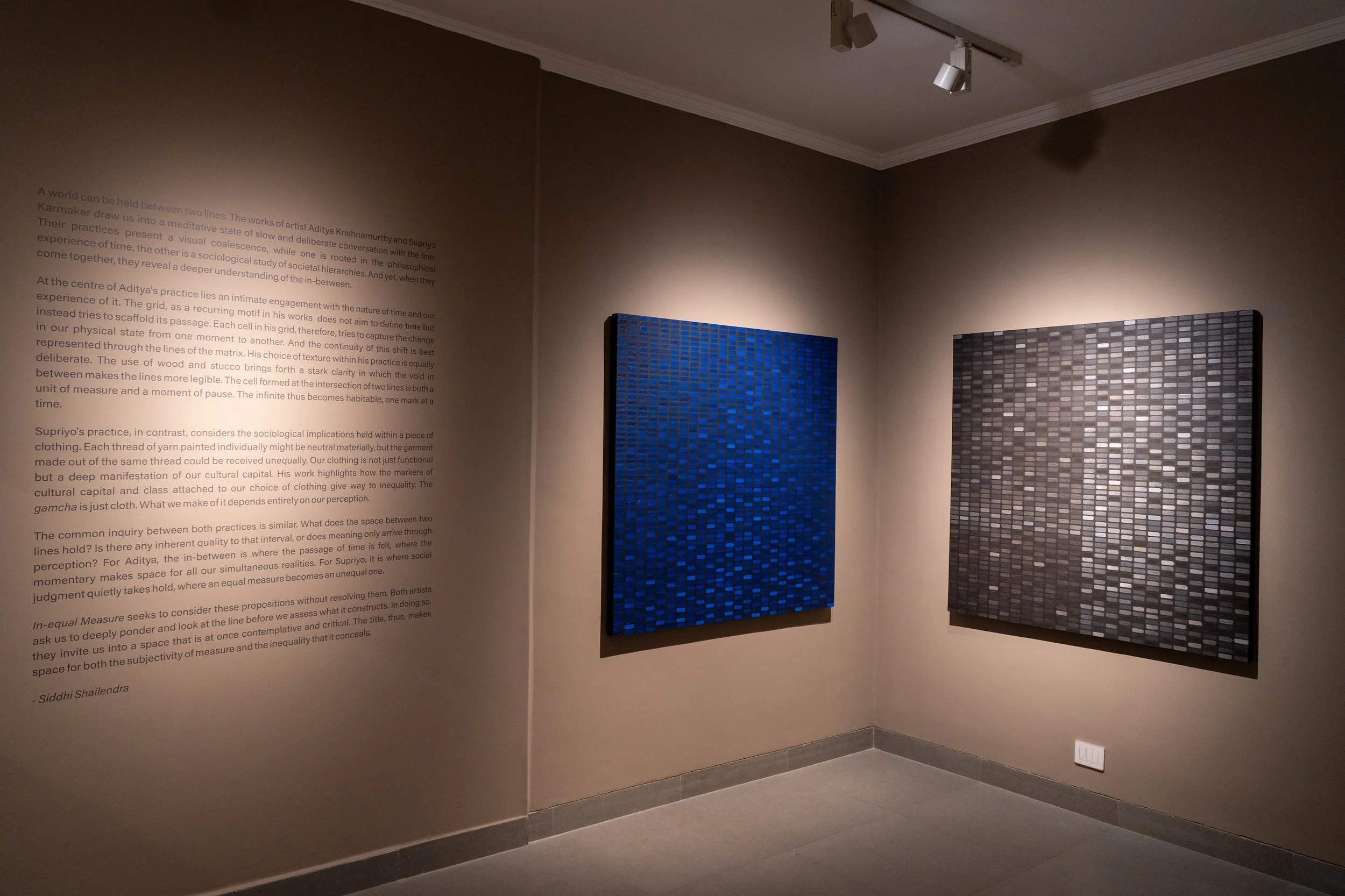
A world can be held between two lines.
The works of artist Aditya Krishnamurthy and Supriyo Karmakar draw us into a meditative state of slow and deliberate conversation with the line. Their practices present a visual coalescence, while one is rooted in the philosophical experience of time, the other is a sociological study of societal hierarchies. And yet, when they come together, they reveal a deeper understanding of the in-between.
At the centre of Aditya’s practice lies an intimate engagement with the nature of time and our experience of it. The grid, as a recurring motif in his works, does not aim to define time but instead tries to scaffold its passage. Each cell in his grid, therefore, tries to capture the change in our physical state from one moment to another. And the continuity of this shift is best represented through the lines of the matrix. His choice of texture within his practice is equally deliberate. The use of wood and stucco brings forth a stark clarity in which the void in between makes the lines more legible. The cell formed at the intersection of two lines is both a unit of measure and a moment of pause. The infinite thus becomes habitable, one mark at a time.
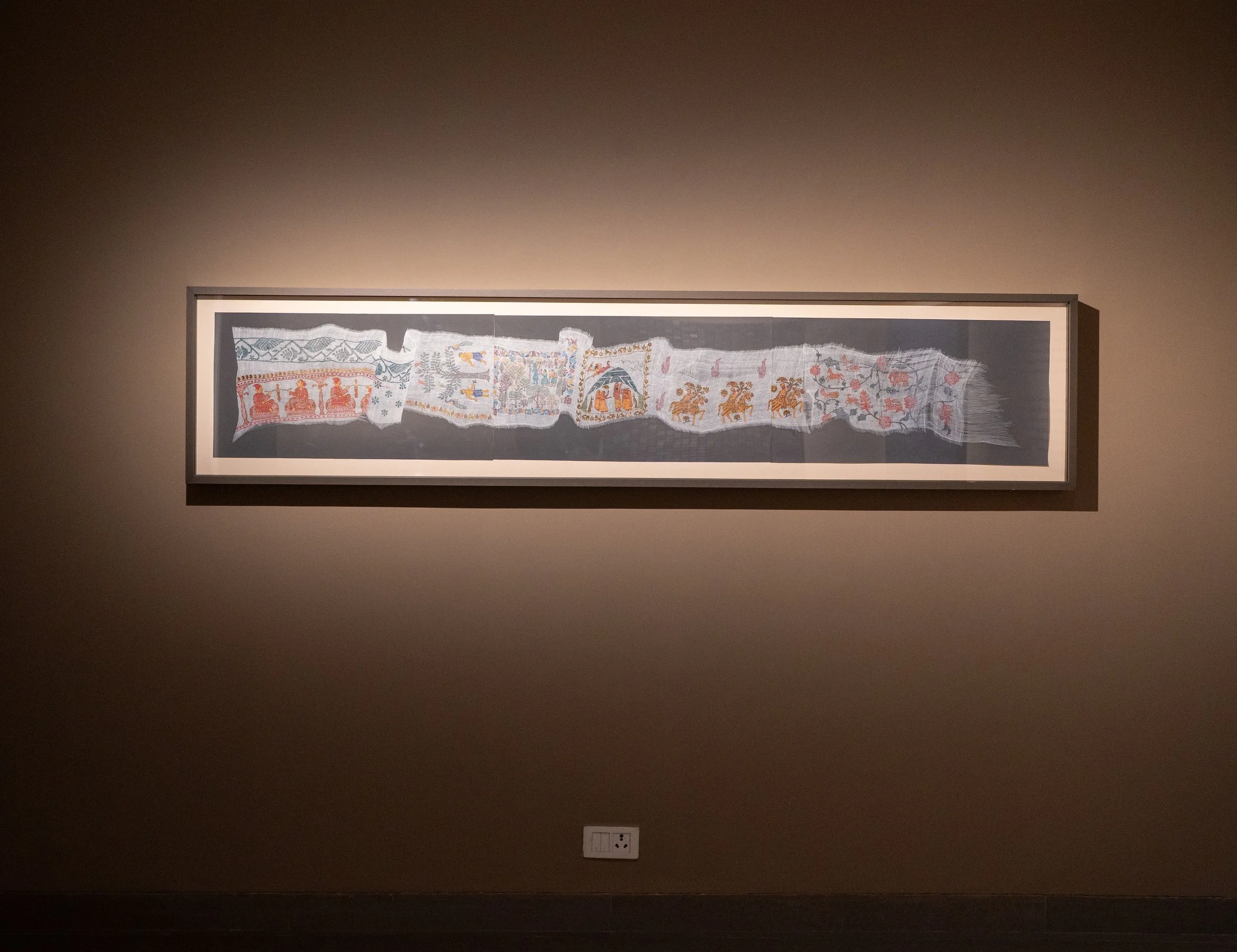
Supriyo’s practice, in contrast, considers the sociological implications held within a piece of clothing. Each thread of yarn painted individually might be neutral materially, but the garment made out of the same thread could be received unequally. Our clothing is not just functional but a deep manifestation of our cultural capital. His work highlights how the markers of cultural capital and class attached to our choice of clothing give way to inequality. The gamcha is just cloth. What we make of it depends entirely on our perception.
The common inquiry between both practices is similar. What does the space between two lines hold? Is there any inherent quality to that interval, or does meaning only arrive through perception? For Aditya, the in-between is where the passage of time is felt, where the momentary makes space for all our simultaneous realities. For Supriyo, it is where social judgment quietly takes hold, where an equal measure becomes an unequal one.
In-equal Measure seeks to consider these propositions without resolving them. Both artists ask us to deeply ponder and look at the line before we assess what it constructs. In doing so, they invite us into a space that is at once contemplative and critical. The title, thus, makes space for both the subjectivity of measure and the inequality that it conceals
- Siddhi Shailendra
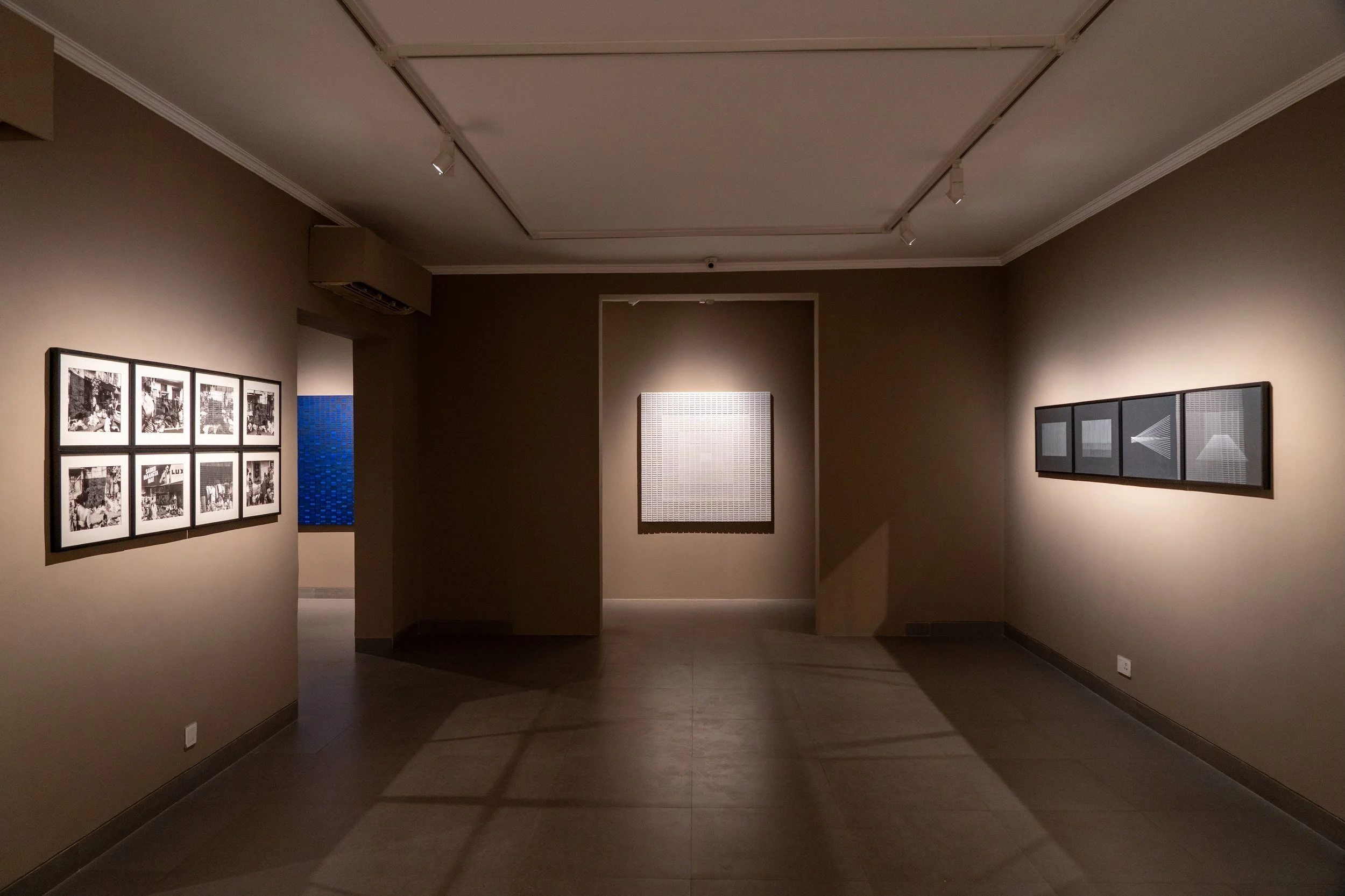
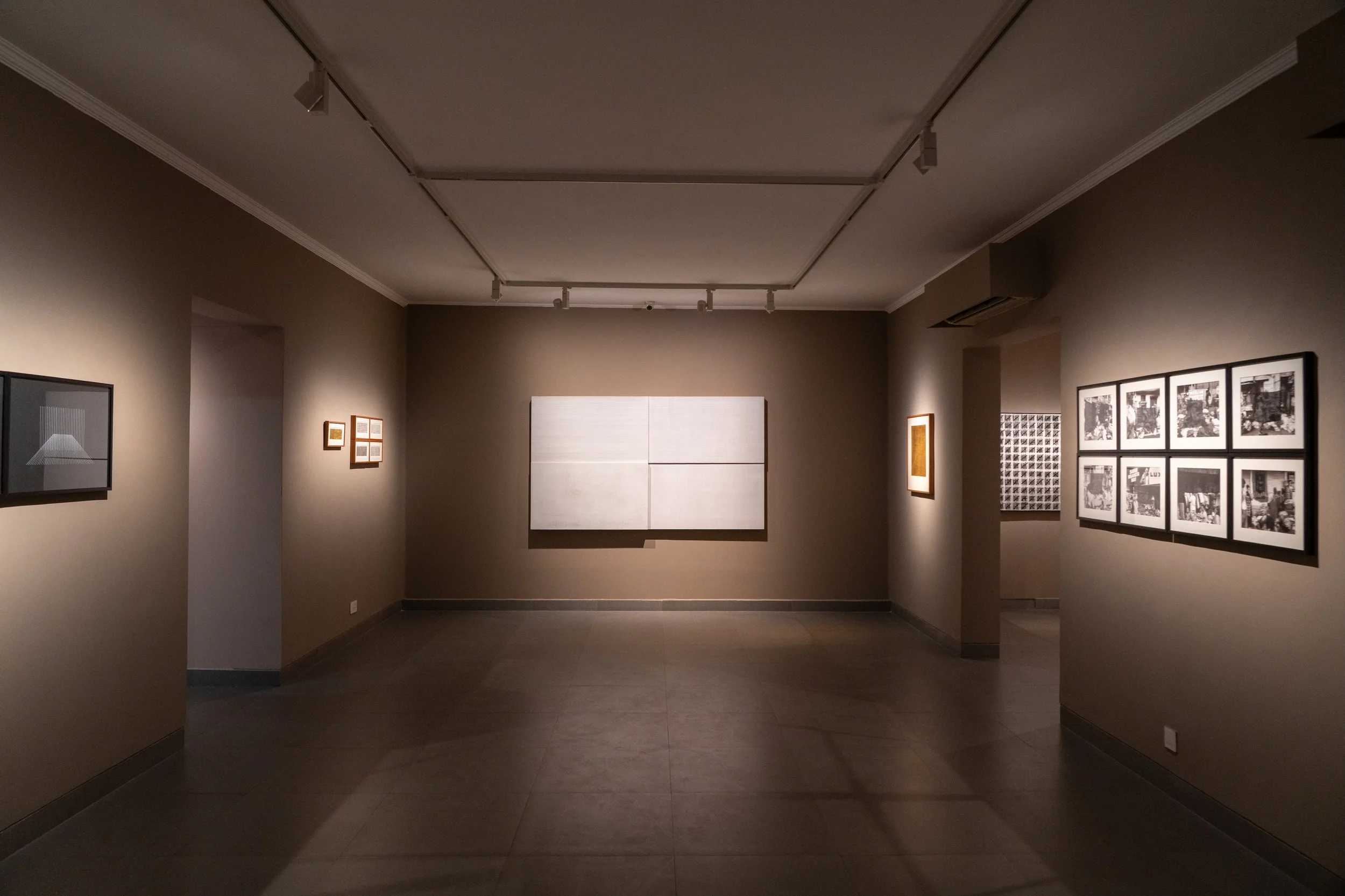
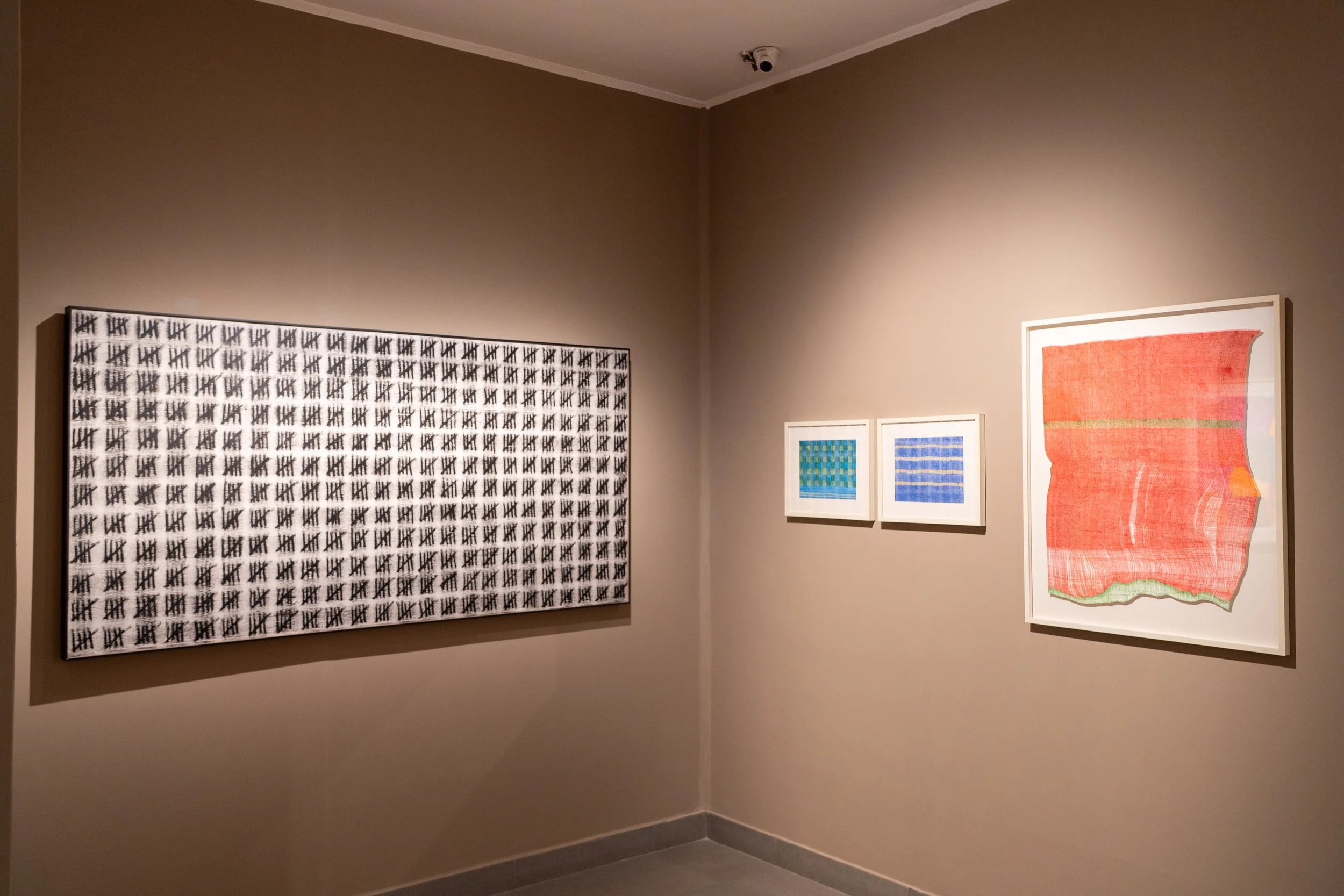

Aditya Krishnamurthy | The wait no.2 | Acrylic paint and texture medium on wood panel | 48 x 48 in | 2025

Aditya Krishnamurthy | Anatomy of time | Acrylic texture medium on wood panel | 48 x 84 x 4 in | 2024

Aditya Krishnamurthy | Untitled (duality) | Acrylic on wood panel | 48 x 48 in | 2025

Aditya Krishnamurthy | Keeping score no.2 | Oil on wood panel | 36 x 72 in | 2024
Aditya Krishnamurthy | Monday | Acrylic on wood panel | 48 x 48 in | 2025

Aditya Krishnamurthy | Red letter day no.1 | Acrylic paint and texture gel on gesso board | 24 x 36 in | 2022
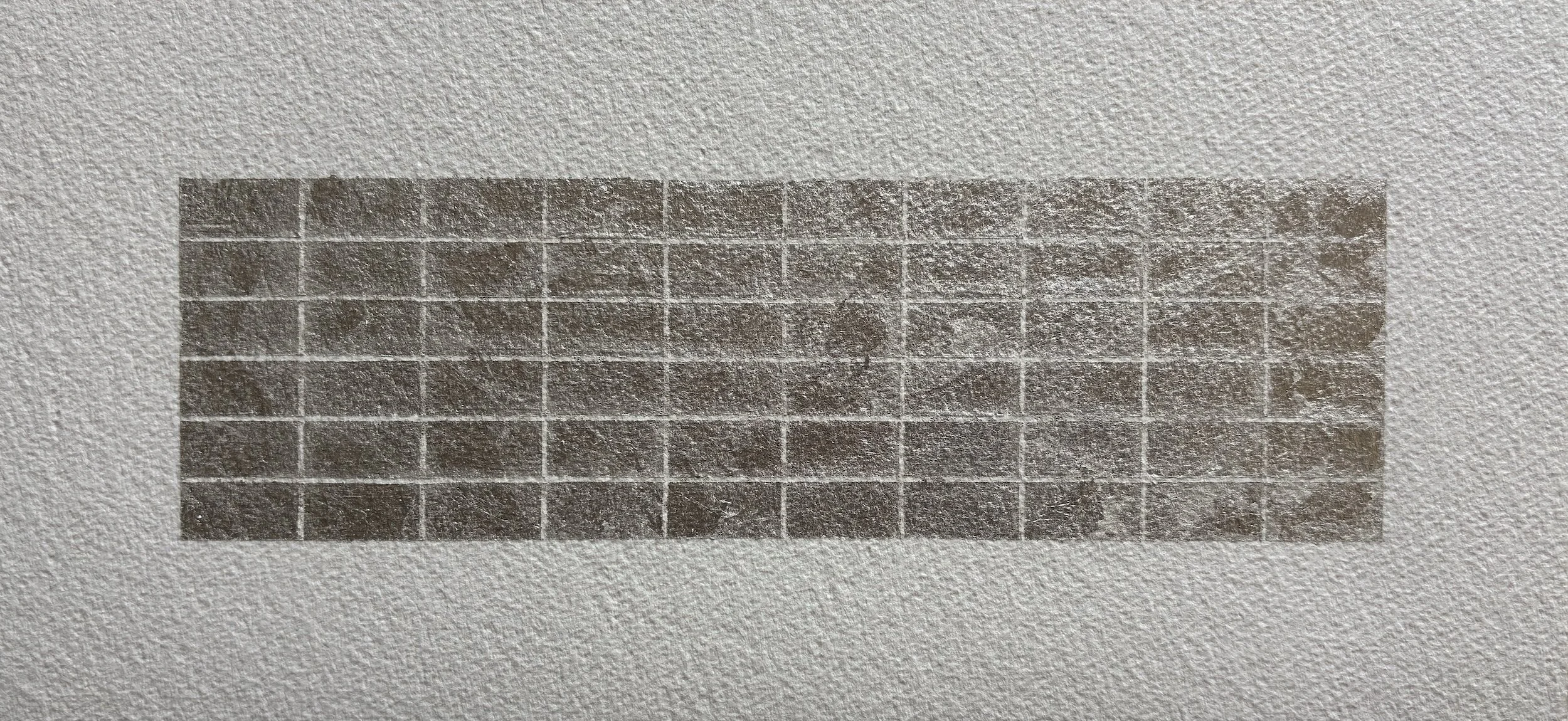
Aditya Krishnamurthy | Witching hour no.6 | Silver leaf on paper | 6 x 13 in | 2026

Supriyo Karmakar | Mundane Meadow I | Pen & Ink on paper | 61 x 29 in | 2022

Supriyo Karmakar | Memory Loom III (Triptych) | Gouache, acrylic and gold leaf on paper | 24 x 96 in | 2026

Supriyo Karmakar | Untitled | Watercolor on Paper | 8.5 x 11 in | 2024
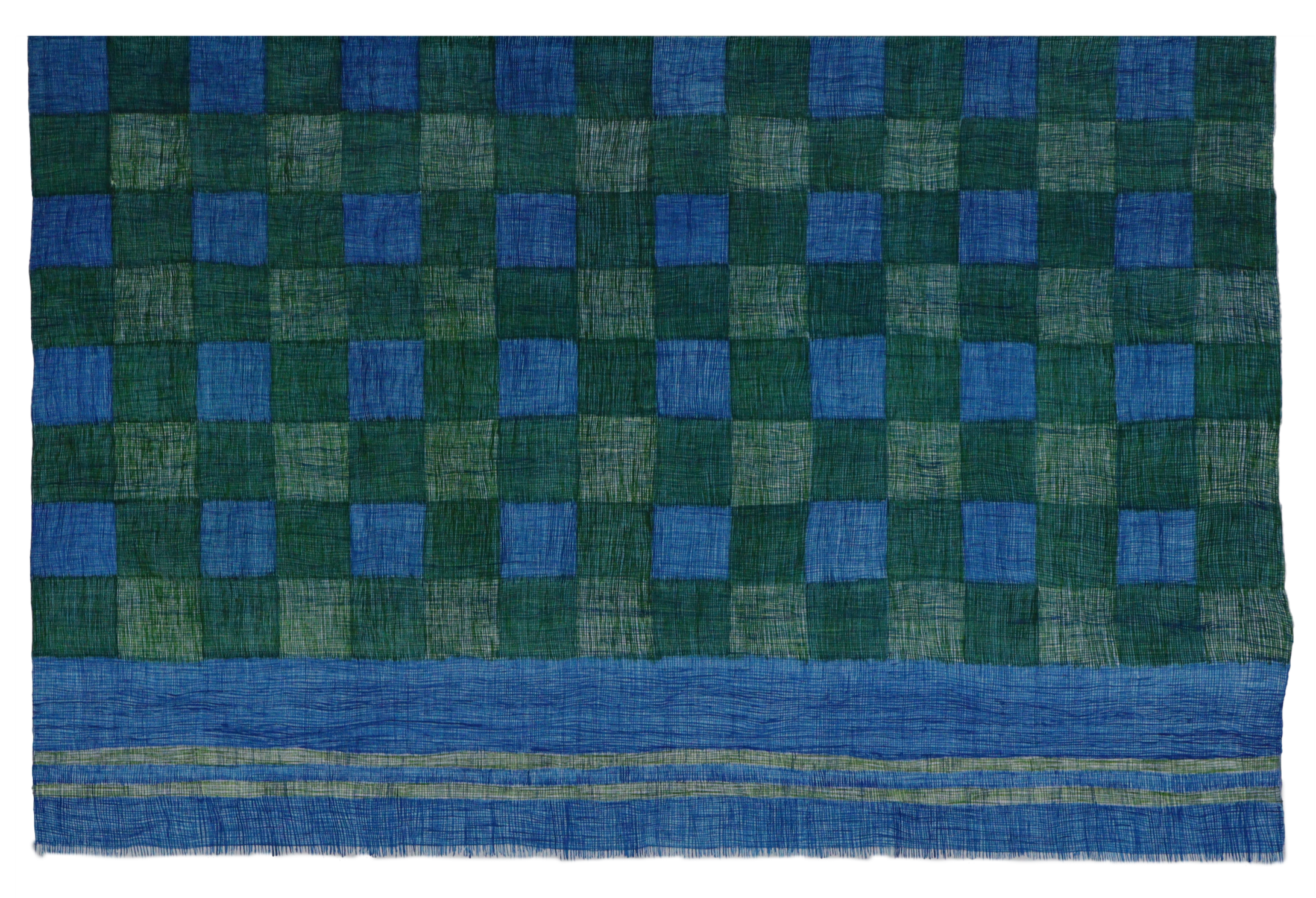
Supriyo Karmakar | Untitled | Watercolor on Paper | 8.5 x 11 in | 2024

Supriyo Karmakar | The Emeritus | Watercolor on Paper | 34 x 48 in | 2024

Supriyo Karmakar | Memory loom II | Gouache, Silver & Gold leaf on paper | 30 x 30 in | 2025
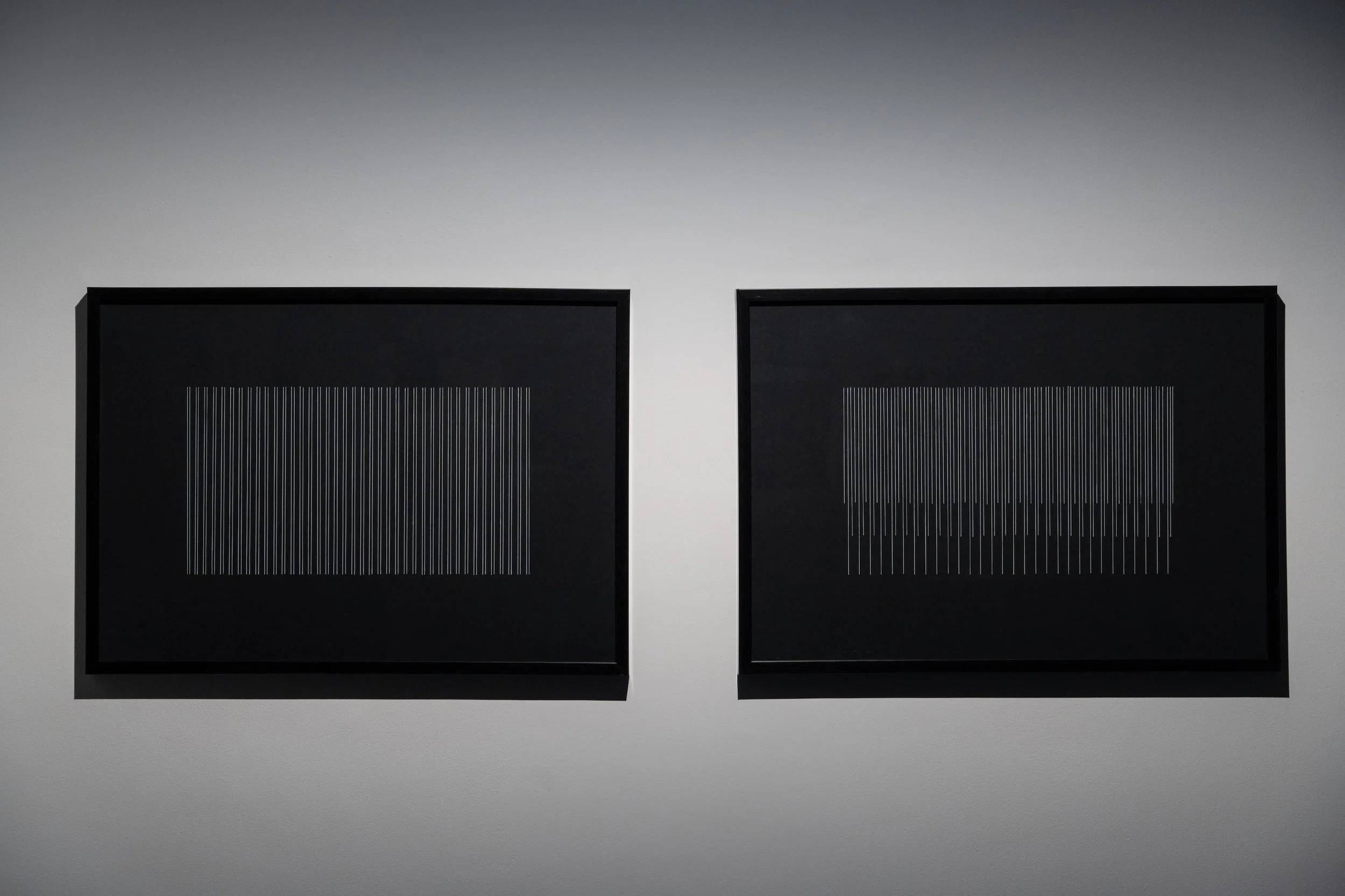
Supriyo Karmakar | Layer on Layer 2.0 | Pen & ink on Paper | 23 x 16.5 in | 2024
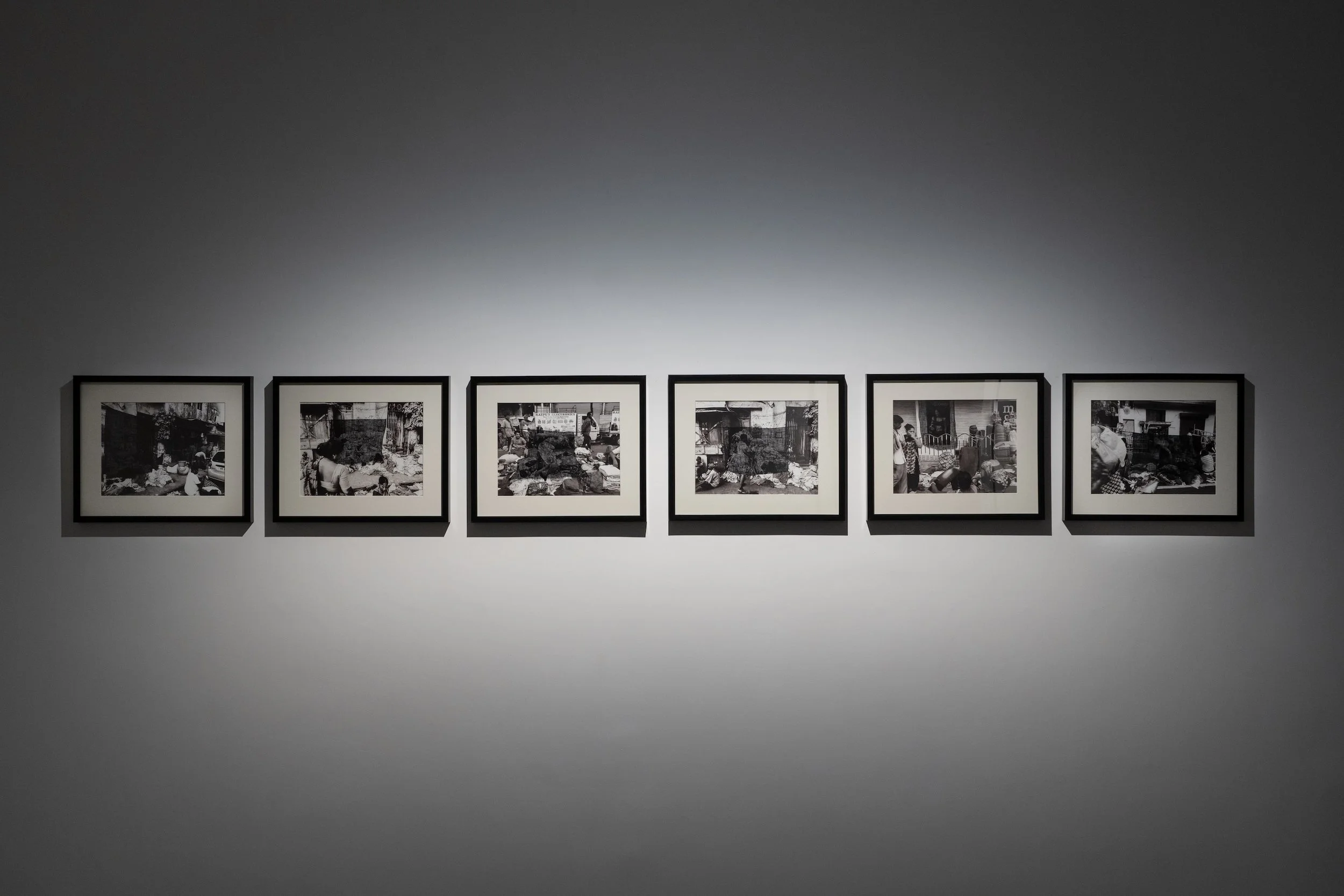
Supriyo Karmakar | Behind The Screen 2.0 | Pen & Ink on Archival Print | 8.3 x 11.7 in | 2024
Aditya Krishnamurthy
Aditya Krishnamurthy (b. 1984) is a self-taught artist who brings to his practice a decade of experience in the Indian financial sector, and with it a sharp, analytical sensibility that continues to shape his artistic vision. His BA in Economics and Philosophy from Pitzer College, Claremont, California, and subsequent studies in graphic design, typography and image making through the California Institute of the Arts, have further deepened his engagement with ideas of structure, measure and meaning.
At the core of Aditya's practice lies an intimate exploration of time as an objective phenomenon and as a lived human experience. Using the grid as his primary framework and grounded in processes of measurement, construction and repetition, his calm, contemplative works invite viewers into a space where time, measure and meaning coalesce.
Aditya has undertaken commissions for private collectors in Mumbai, Singapore, London and Los Angeles, and has created commissioned works for India Development Review and Scholastic India. In 2025, he participated in the online group exhibition In Time Again, curated by Farah Siddiqui Khan for Cultivate Art. He has been selected as one of twelve artists for The 'River' Residency, a collaborative India–UK programme to be held on the banks of the Chambal River, Uttar Pradesh, later in 2026.
The artist lives and works in Mumbai, India.
Supriyo Karmakar
Supriyo Karmakar(b. 1991) is a multidisciplinary artist based in Kolkata, India. An art practitioner and educator, he completed his BFA from IKSV, Khairagarh and MFA from the University of Kalyani, West Bengal. His core practice is drawing and painting, he also works on collaborative research-based projects, kinetic sculpture, performance and video art. After completing his post-graduation he has participated in residences such as “Kala Setu” at Utsha Foundation for Contemporary Art, Kalakriti Art Residency, Hyderabad. He has been involved in several art projects like “Visible and Invisible Line,” “Wave of the City” at Kochi Muziris Students Biennale 2018, a Collaborative project with artist Niroj Satpathy at FICA Reading Room in 2019, ‘Black on Black’ organised by “Philosophy Unbound” at JNU, Delhi. He is the recipient of several grants and awards such as the Khoj Support Grant 2020, Pandemic as Portal Art Grant, One Shanti Road 2021, and Sarala-Basant Kumar Birla Award at Birla Academy of Art and Culture 2023.